
Re-thinking Org Design
Re-thinking Org Design – How Structure Becomes Your Strategic Advantage
December 2025 | Koen Veltman
What if your org structure is the real bottleneck? Not the market. Not your people. Not your product. The structure itself. There is this famous quote from David Packard (the P in HP):"More businesses die from indigestion than starvation," meaning that organizations are mostly challenged by execution, rather than by a lack of ideas or opportunities. Org structure is your means to create that internal effectiveness.
We all sense the friction, the fog, the endless loops of “Who owns this?” and “Why is this still not moving?” With today's new rules for org structure, you can design it with clarity. No, just old school hierarchies ("harkjes" as we like to say in Dutch) that drive an administrative system, but a real, powerful strategic weapon.
Before exploring solutions, consider the challenges involved. Let's be upfront about the downsides of org design.
It's never perfect. It can't be perfect. If you try to solve everything, then you solve nothing. It's really about making choices, and few companies make enough choices.
Org design needs honesty and introspection. Know what you aren’t solving, and make it explicit. Tell your organization where you lack effectiveness, not just what should work. Org charts only focus on what should work, making other, less effective lines invisible—but they exist.
Flexibility is scary. Make it low-effort and flexible, not high-effort and rigid. In today's rapidly changing world, you have to accept and expect to change your org structure more often. Then low effort and flexible changes really help.
It will be distracting. In most management teams 80% of attention goes to 20% of activities/issues. And most often the organizational topics. What are the team topics that distract you but shouldn't?
Multiple structures. We are used to trying to design everything into a single structure, which creates a lot of complexity. Isn’t it simpler to design multiple structures? It sounds complicated, but when you get used to it, it creates clarity. For example, one agile structure of small cross-functional teams to own customer journeys, and another, functionally driven, structure with large specialist teams focused on knowledge development and expertise growth.
This article is about org design. But it's never the real solution. Org design is just the starting point. Give x times more attention to how you make a good structure work (implementation, communication, and behavior change!), and how you keep it healthy (team building!), and its process and systems.
Enough for context, let’s dive into how to do org design as well as we can. These six design principles force you to think very differently about how that system should work. Even here, you need to choose: which design criteria are most important right now for your next organization iteration?
Read the “what good vs bad looks like” and assess where your organization stands:
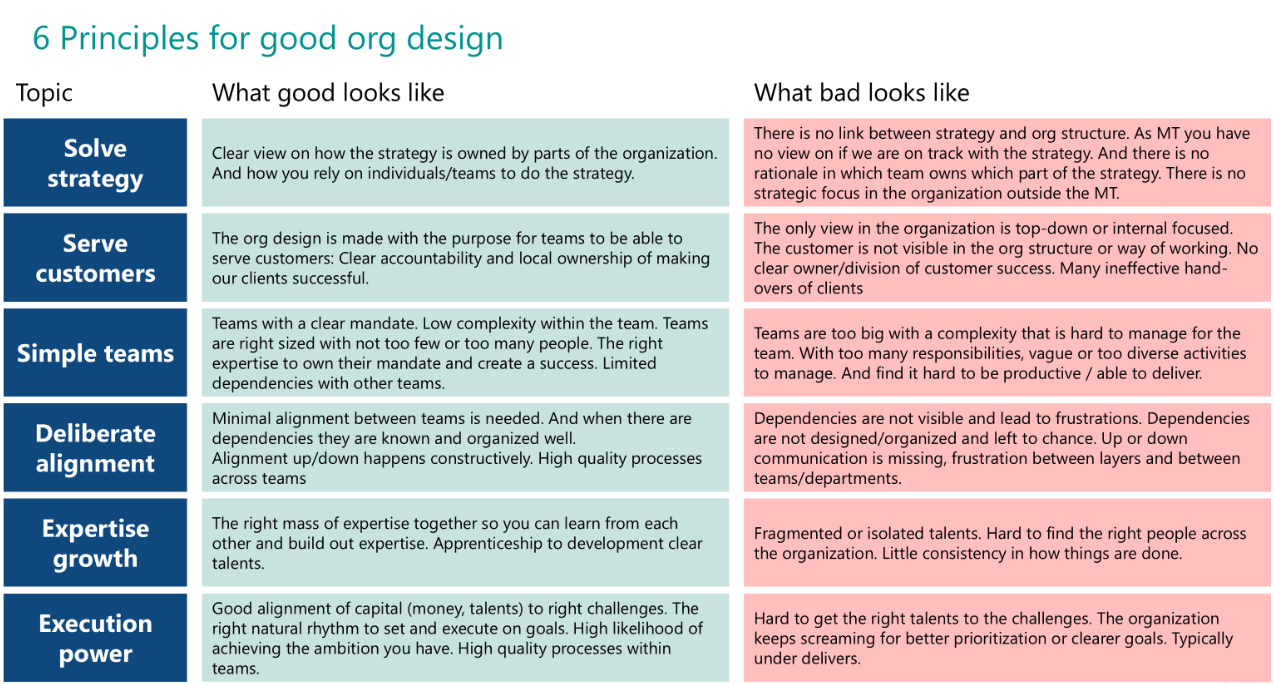
1. Solve Strategy
It sounds obvious: org design should help solve your strategy. But when I ask leaders, “Show me how your org structure helps you work on your strategy?” they recognize their answer is not satisfying at all. If there is a disconnect between how you create structure and how you like to create ownership of your most important goals, you create bureaucracy by design. It's much easier to organize around static functions or other types of business units. It feels practical, but it blinds you. A strong org design makes the strategy visible in who owns what. It shows clearly which parts of the strategy live with which teams, and how those teams have real ownership for strategic success and turn it into action. Ownership creates speed in strategy execution. Ambiguity drains it.
When strategy lives only in leadership decks and off-sites, the organization guesses its way through the year. When strategy lives inside the structure, teams know exactly why they exist and what they must deliver.
If your structure doesn’t make the strategy obvious, you don’t have a structure. You have a collection of people.
2. Serve Customers
The goal of the org structure is not to visualize management roles (the hierarchy). But it is to serve your customers (or in self-oriented words, "make your organization successful"). So don't start from the top; start with the best way to serve your customers. Who do you bring together to serve a customer? Who needs to be on a team or in a single flow? And can you design to make that as good as possible? And then organize all other activities around supporting those customer teams?
If the customer is not visible in your organizational design, your teams will spend most of their energy serving internal processes. Customers don’t care about your internal flow. They care about results. Can you make teams really accountable for the results customers care about?
Teams need clear accountability for specific parts of customer success. This reduces handovers, shortens decision paths, and builds real ownership. When the org revolves around the customer, work becomes sharper, faster, and more meaningful.
Customer-centric structure is not a slogan. It is an architectural choice.
3. Simple Teams
We have had a recent history of increasing span of control, because it saves management costs... But larger teams create a lot of complexity within teams, ie, a huge invisible management cost. Complexity doesn’t show up all at once. It slips in quietly through managing multiple processes or products, hybrid roles, vague mandates, and teams that grow without direction. Before you know it, the internal team structure becomes a maze.
Simple teams are not simplistic. They are focused. They have a clear mandate, the right size, and the right mix of expertise to deliver. They carry minimal internal noise and limited dependencies. This creates resilience and performance.
Worried about your manager's span of control? Have 1 manager manage multiple small teams, instead of 1 big one. Or go for part-time leadership; a leadership role does not have to be full-time; you can do much more meaningful work within a team than just managing it.
Big teams with blurry responsibilities are busy but weak. Small, sharp teams are productive and strong.
4. Deliberate Alignment
Alignment is the new hierarchy. You do not need more layers or more approvals to create coherence. You need visible, intentional alignment between teams.
Real alignment means teams know their dependencies, work within clear rhythms, and escalate issues through agreed paths. It turns coordination into a practice rather than a surprise. When alignment is invisible, frustration becomes the default. People feel blocked, not supported. And you cannot coach your way out of structural chaos.
Good design for alignment requires a real mindset shift. From finding your own team or position important, to working together with very little ego on what is most valuable for your customer. Then you can openly align and prioritize together.
5. Expertise Growth
Expertise does not grow in isolation. SMEs often scatter specialists across teams for flexibility, but what they really create is fragmentation. People stop learning from each other. Craft weakens. Standards drift.
Strong structures cluster expertise so that people can learn together, exchange patterns, and build depth. Apprenticeship is not old-fashioned. It is a proven engine for high performance. If you want mastery, design for mastery. Is this the old-school functional hierarchy? Maybe, but with a different purpose, it's not designed to own all the business goals; it should be purely designed for what it's good at: expertise growth.
6. Execution Power
Execution power is not a talent problem. It is a design outcome. Many founders hire smart people and then starve them of the clarity, alignment, and decision rights they need to deliver.
When teams face the right challenges with the right rhythm, they create speed. When they operate without structure, they create noise and rework. Firefighting becomes normal. Progress becomes accidental. Execution improves when your structure channels energy rather than drains it.
So what does this all mean for real organizational impact?
Org structure is not administrative overhead. It is leverage. It determines how fast you can move, how clearly you can decide, and how confidently your teams can execute. A strong structure makes the strategy visible, puts the customer at the center, simplifies teams, aligns deliberately, grows expertise, and strengthens execution.
A weak structure does the opposite, and you feel it every day. Dare to redesign. Dare to decide. Clarity creates energy. Build with courage.