
Everyone is experimenting with AI. So why does almost nothing change?

AI dominates the conversation. Teams prompt. Leaders demo. Organizations announce that “everyone has access to ChatGPT.” Time spent in AI tools increases.
Business impact does not.
What most companies see follows a familiar pattern. A small share of work moves into AI tools. That delivers small efficiency or quality gains in isolated tasks. Across the full workflow, the effect disappears. More activity. Same outcomes.
This is not a limitation of AI. It is a limitation of how organizations approach change. They optimize parts of work instead of redesigning how work flows end to end.
AI automation is not a technical upgrade. It is a change in how work gets done. As with other transformations, results come from shifting process and behavior together. When behavior is left untouched, organizations collect dashboards, demos, and proofs of concept—while performance stays the same.
This article is grounded in two observations from practice. First, effective AI transformation has distinct layers, and workflow redesign is the lever that creates impact. Second, AI transformation requires behavior change—not as an abstract goal, but as a consequence of changing how work is organized and executed.
Insight 1: Good AI transformation has three parts — and workflow redesign creates impact
Many organizations treat AI transformation as a single initiative. They invest in training, deploy tools, or define a strategy. Each step helps. None is enough on its own. In practice, effective AI transformation unfolds across three layers.
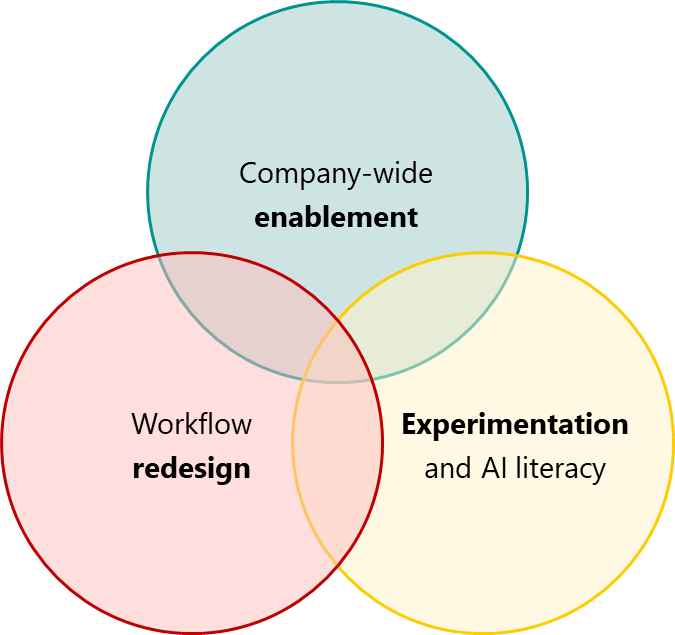
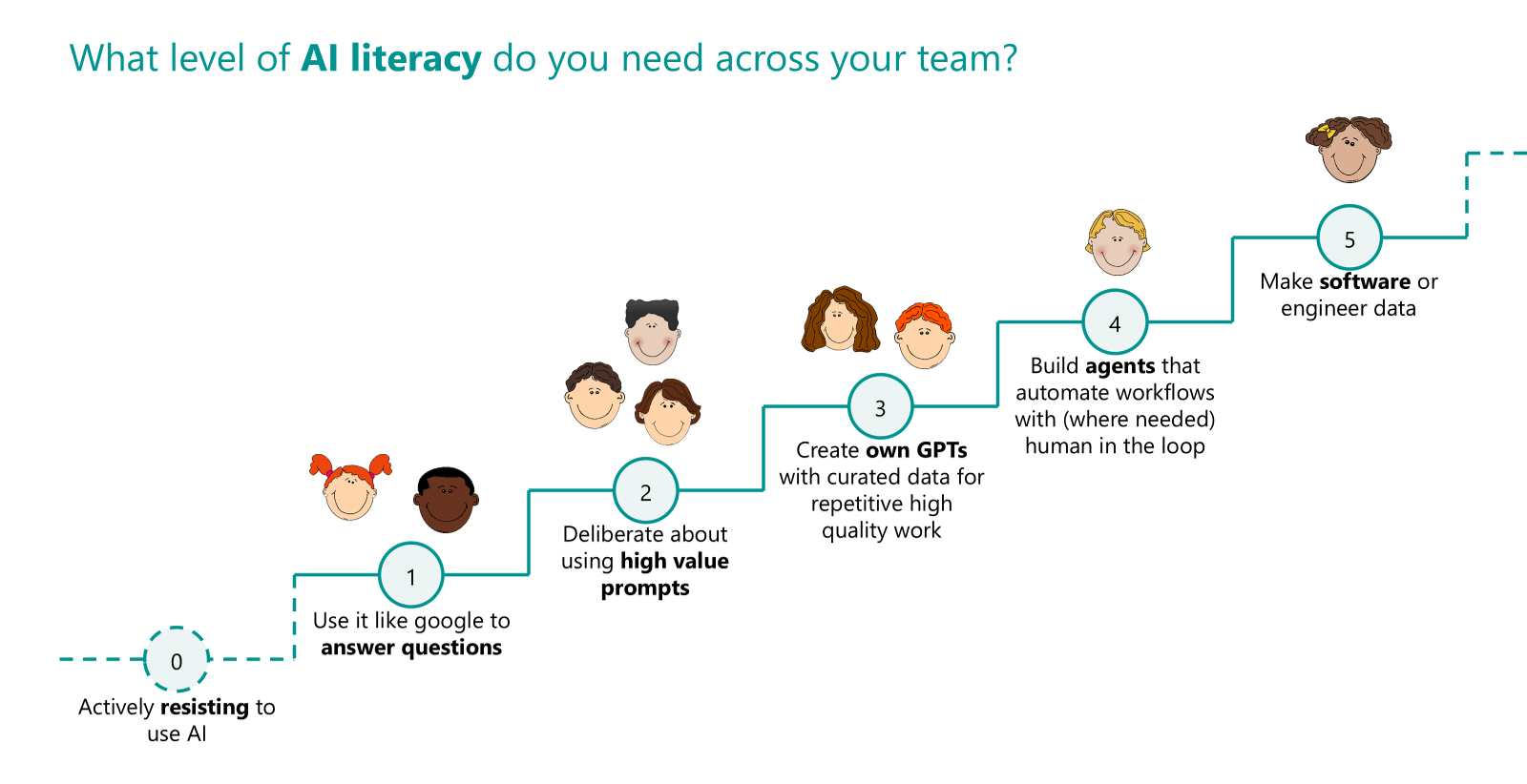
Individual experimentation and AI literacy
The first layer focuses on individuals. People learn to use AI tools, experiment with prompts, and apply AI to their own tasks. This builds confidence and lowers resistance.
The impact remains limited. Personal productivity improves, but only at the margins. This layer prepares the organization. It does not transform it.
Company-wide enablement
The second layer operates at the organizational level. Leadership connects strategy to technical architecture, governance, and investment decisions. AI initiatives stop being isolated experiments and start to scale.
This layer is often reduced to tooling. That is a mistake. Real enablement requires unlocking data for teams, setting clear rules for security and privacy, and creating space for new expertise, learning paths, and roles. Without this, AI use fragments and stalls.
Workflow redesign — where AI changes performance
The third layer is where AI starts to create impact. Teams stop inserting AI into existing tasks and start redesigning how work flows end to end. The key question shifts from “How can I use AI?” to “How should this process work now that AI is available?”
Teams work in the business and on the business at the same time. This is structural change, not optimization. When done well, it produces multiples of impact rather than incremental gains.
Decisions move earlier. Handovers shrink or disappear. Roles are redefined. Quality controls change. Data flows become explicit.
Workflow redesign does not happen by itself. It requires focus, clear intent, and guidance. Without it, AI remains optional—and optional tools rarely change outcomes.
Insight 2: AI transformation requires behavior change
AI reshapes how decisions are made, how work is organized, and how value is created. That makes AI transformation a behavioral challenge as much as a technical one.
As AI becomes part of everyday execution, teams face a dual shift: they must adapt how they work with AI in daily operations, and how they work on AI by continuously reshaping workflows, roles, and decision structures.
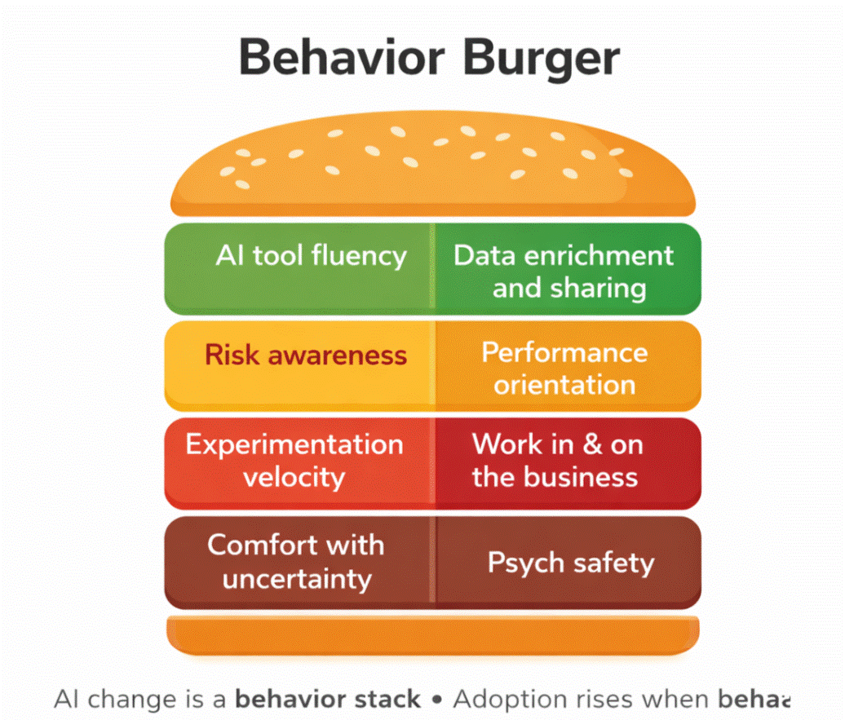
The framework captures the shift teams face in working with AI as part of daily execution, and working on AI by continuously reshaping how work is organized and improved.
| Behavior | What it is | What AI changes — and what that requires |
|---|---|---|
| AI tool fluency | Working productively with AI tools as part of everyday tasks, not as a side activity. | AI collapses the gap between idea and execution. Teams have to treat AI use as a core work practice, not a task delegated to IT. The ease of use of your AI tools will be a key job differentiator. |
| Data enrichment and sharing | Making data accessible, usable, and reusable across teams as part of daily work. | AI multiplies the value of shared data. That shifts the organization from data hoarding to deliberate contribution toward common data foundations. You excel at finding data, connecting data and making it available to others. |
| Risk awareness | Addressing security, quality, and compliance as part of normal work. | AI introduces new risks at speed. This requires everyone to be risk aware and understand the governance guardrails, without slowing AI adoption down. |
| Performance orientation | Regularly measuring success by outcomes rather than activity. | AI increases performance standards significantly. Daring to be bolder and challenge harder. Set and work towards higher standards month-over-month instead of year-over-year. |
| Experimentation velocity | Running fast, disciplined, and creative experiments with explicit learning goals. | AI use cases change faster than planning cycles. This requires teams to learn through very short cycles that combine speed with rigor instead of choosing either or. |
| Working in and on the business | Delivering results while redesigning processes at the same time. | AI changes work while work is happening. This requires teams to create space for reflection and redesign without pausing execution. To be aware and in control of their processes, not just executing them. |
| Comfort with uncertainty | Making decisions using probabilistic outputs while tools and assumptions continue to change. | AI requires us to embrace uncertainty. With the new pace of change, teams need to be aware of what actual uncertainty is. Teams need to act with judgment, update decisions often, and accept shorter planning horizons. |
| Psychological safety around change | Openly discussing how roles, responsibilities, and expectations evolve as work changes. | AI requires vulnerability. We all face extra uncertainty in our jobs so we need to dare to be open about it, and care for each other. This requires teams to surface concerns early and solve it together, not wait until HR or management solves it for them. |
Why workflow redesign is the key to impact
Training, tools, and strategy all matter. Without workflow change, behavior defaults back to old patterns.
Workflows shape habits. Habits shape results. Old workflows produce old outcomes, regardless of technology.
Workflow redesign creates the conditions for new behavior. It makes AI part of the work rather than an optional add-on. It turns capability into performance.
This is why focused, team-based redesign cycles matter. They allow teams to work on real processes, with ownership, constraints, and measurable outcomes—rather than abstract use cases.
A practical way forward
AI transformation does not require long programs or years of planning. It requires focus on the right level of change.
Teams start by building basic fluency and organizational enablement. From there, progress comes from selecting a real, high-impact workflow and redesigning it end to end with AI in mind. Learning happens in the work itself: through shared experiments, clearer decisions, and visible effects on performance. What works is carried forward. What does not is adjusted.
This approach keeps AI grounded in execution. It avoids endless experimentation without results, as well as large-scale rollout without learning. Capability and performance develop together, in real work, at a pace teams can sustain.
AI automation is ultimately not about speed. It is about choice. Which work should humans continue to do? What should change? And which workflows need to be redesigned now that intelligent systems are part of everyday execution?
Organizations that treat AI as a workflow redesign challenge move beyond experimentation. They create new habits, new capabilities, and new outcomes—starting with one team, one process, and a clear intent to learn. That is where meaningful AI transformation begins.