
HR’s Hidden Responsibility
HR is responsible for something most organizations quietly ignore: how well teams actually work together. Companies invest enormous effort into hiring talented individuals, defining performance goals, and designing compensation systems. But the system that ultimately determines whether those individuals succeed is the team they work in. If teams function well, individual talent multiplies. If teams function poorly, even great people underperform.
This points to a responsibility that often goes unspoken, but clearly sits with HR. Across the employee lifecycle, HR supports a wide range of processes that shape how organizations operate: recruitment and selection, onboarding, performance management, talent development, career progression, compensation, succession planning, engagement, employee relations, organizational changes, and offboarding.
Some of these responsibilities are widely recognized. Recruitment, for example, is clearly understood as an HR process. Performance reviews and salary adjustments receive regular attention because they are formal and visible. But some processes that strongly influence organizational success receive far less structural attention. Team effectiveness is one of them.
Many organizations assume that strong teamwork will naturally emerge if you simply hire talented individuals and give them clear goals. In practice, that assumption rarely holds. Most teams have never actually learned how to collaborate effectively. They learn through trial and error, if they learn at all.
The real value of a great team
The value of great teamwork is rarely questioned. Most professionals have experienced what it feels like to be part of a truly great team. Yet organizations often treat those experiences as exceptions rather than deliberately designing for them. Despite the clear benefits, many companies still fail to invest in making high-performing teams the norm rather than the exception.
Here are the hard facts: Research consistently shows that team quality has a major impact on business performance.
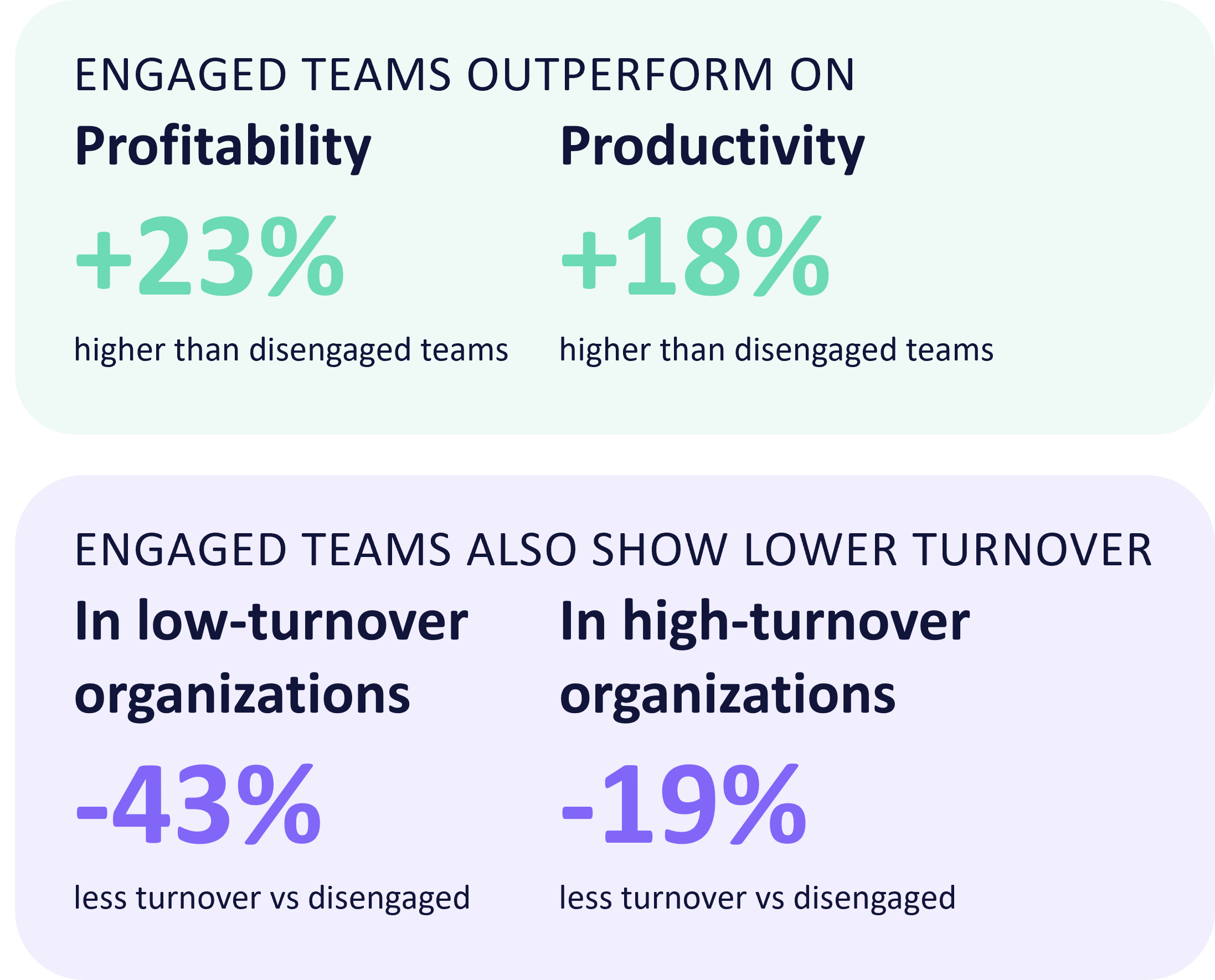
• Gallup research shows that highly engaged teams achieve 23% higher profitability and 18% higher productivity compared to disengaged teams, while also experiencing significantly lower absenteeism and turnover.
Source: https://www.gallup.com/workplace/236927/employee-engagement-drives-growth.aspx
• The same Gallup research also found that highly engaged teams experience 43% lower turnover in low-turnover organizations and 19% lower turnover in high-turnover organizations.
Source: https://www.gallup.com/workplace/236927/employee-engagement-drives-growth.aspx
• Similarly, Google’s well-known Project Aristotle study found that the most important predictor of team success was not individual intelligence or seniority, but the quality of team dynamics, especially psychological safety.
Source: https://rework.withgoogle.com/print/guides/5721312655835136/
• Research from McKinsey also shows that organizations with strong team collaboration are significantly more likely to outperform their peers in terms of productivity, innovation, and employee satisfaction.
Source: https://www.mckinsey.com/capabilities/people-and-organizational-performance/our-insights/the-organization-blog/why-organizations-need-teams
• And research from MIT’s Human Dynamics Laboratory found that communication patterns within teams are the single most important predictor of team performance, outweighing factors such as individual intelligence, personality, or skill.
Source: https://mitsloan.mit.edu/ideas-made-to-matter/new-science-building-great-teams
In other words, companies invest heavily in hiring great individuals, but the real performance multiplier happens at the team level. Yet compared to recruitment, performance management, or compensation, team effectiveness is rarely treated as a core organizational capability.
Instead, many organizations treat team building as an occasional intervention: an off-site workshop, a facilitated session, or a one-time training. That approach rarely produces lasting change. If teamwork truly drives performance, then developing it should be treated like any other capability inside an organization: structured, continuous, and supported by clear processes.
A different way to think about team building
Managers are left to figure out how to lead their teams and make them effective. They don’t get trained, have access to a tool, or use a trusted process to help them build a great team. Traditional team building often assumes that one workshop, one conversation, or one off-site can “fix” how a team works together.
In reality, effective teamwork develops in very different ways.
Five assumptions help reframe how team building actually works.
Team building is not the manager’s job alone.
Teams function as systems. Managers play a crucial role. Yet, the quality of collaboration depends on the entire team. It is not just the manager’s job. The whole team owns how they collaborate. Shared ownership leads to lasting improvements, not ones that depend on a single leader.Team building is continuous work, not a one-time event.
Healthy teamwork develops gradually. Rather than relying on rare workshops or off-sites, teams improve through regular reflection. Focus on one practical improvement at a time. Short, recurring cycles help maintain and strengthen teamwork over time.Every team develops differently.
Frameworks for teamwork can help. Still, no two teams face the same challenges. Instead of sticking to fixed frameworks or standard exercises, teams should target the most relevant collaboration topics for the current situation.Teams improve through practice.
Just like any other capability, teamwork improves through repetition and practice. Instead of only discussing teamwork during workshops or off-sites, teams need to actively practice new collaboration habits in their day-to-day work. Just like going to the gym, don’t talk about “becoming better at giving feedback”; actively do team-building exercises to build these skills.Insight makes teamwork discussable.
Many teams avoid discussions about collaboration because the topic feels vague or uncomfortable. When collaboration is unclear, the elephant in the room stays undiscussed. Clear insights and a shared framework for improvement topics make it easier for teams to openly discuss and improve how they work together.
Summary:
Traditional vs. Modern Team Building
| Principle | Old approach | New approach |
|---|---|---|
| Shared ownership | The manager is responsible for team effectiveness. | The whole team takes ownership of how they collaborate. |
| Continuous development | Team building happens in occasional workshops or off-sites, especially when things don't go well. | Teams regularly reflect and improve their collaboration in short cycles. Good teamwork is sustained and improved to great teamwork. |
| Context-specific development | Teams follow fixed frameworks or standard exercises. | Each team focuses on the topics that matter most for their situation. |
| Learning through practice | Teams discuss teamwork, but rarely change daily habits. There is a disconnect between a great off-site and the next day back at the office. | Teams actively practice new collaboration habits in their daily work. |
| Insight-driven conversations | Collaboration problems remain vague or avoided. The elephant in the room is rarely discussed. | Choose from a complete framework of team-building improvement topics that are known to all team members. Clear insights make it easy to openly discuss and improve how to work together. |
The opportunity for HR
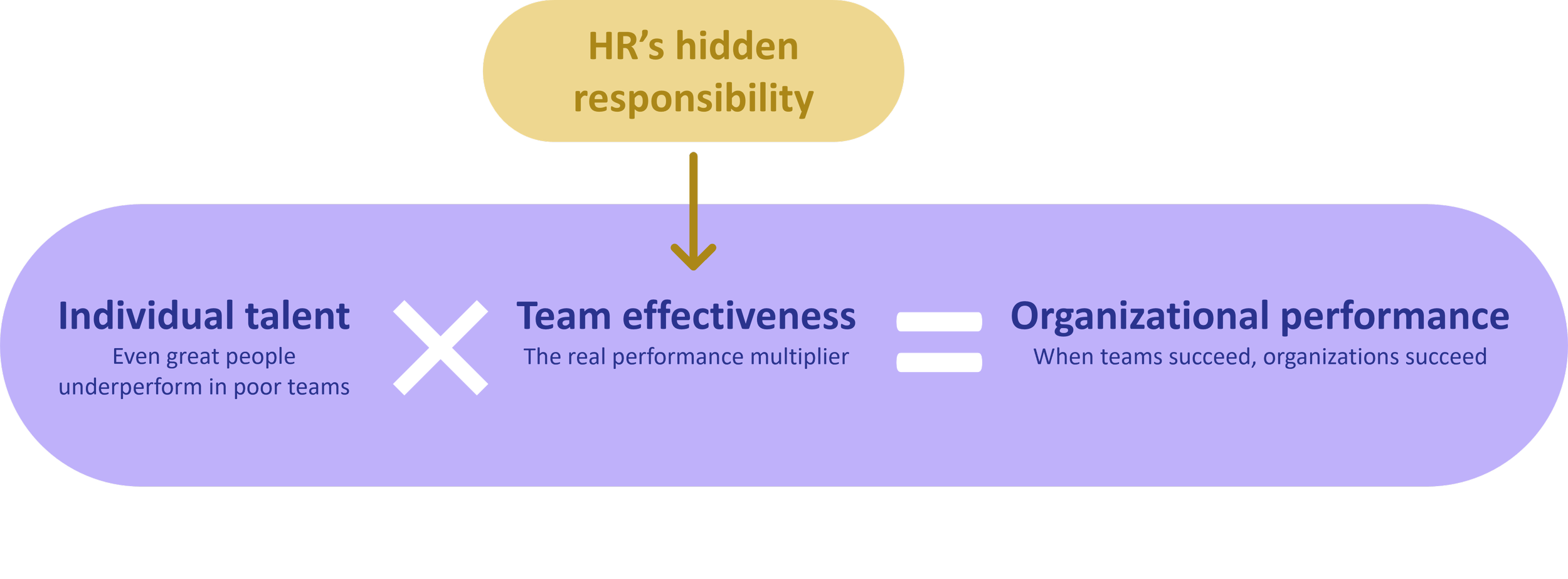
If teams are where individual performance turns into organizational results, supporting team effectiveness becomes a natural extension of HR’s role. HR already builds the infrastructure around hiring, development, performance, and compensation. Team effectiveness can be supported in a similar way: with clear methodologies, scalable tools, and support when teams need guidance.
This article is partly based on insights from Teambooster.app, our platform designed to help teams actively improve how they work together over time. Instead of relying solely on workshops or external facilitators, teams follow a structured approach that helps them regularly reflect on their collaboration and take practical steps for improvement.
HR does not have to become expert team facilitators or coaches; they can rely on timely support from our Teambooster coaches only when needed. Because the approach is platform-based, HR can also gain visibility into recurring collaboration themes across teams in the organization.
When teams take ownership of improving how they work together, and HR provides consistent support for that process across the organization, team building becomes a continuous capability rather than an occasional intervention. This is when HR’s hidden responsibility becomes visible: unlocking the performance potential within teams. The real opportunity for HR leaders is to step into this role intentionally, by championing strong teams, equipping managers and teams with the right tools and structure, and establishing great teamwork as the standard, not the exception.
Because when teams succeed, organizations succeed. And HR is uniquely positioned to make that happen.
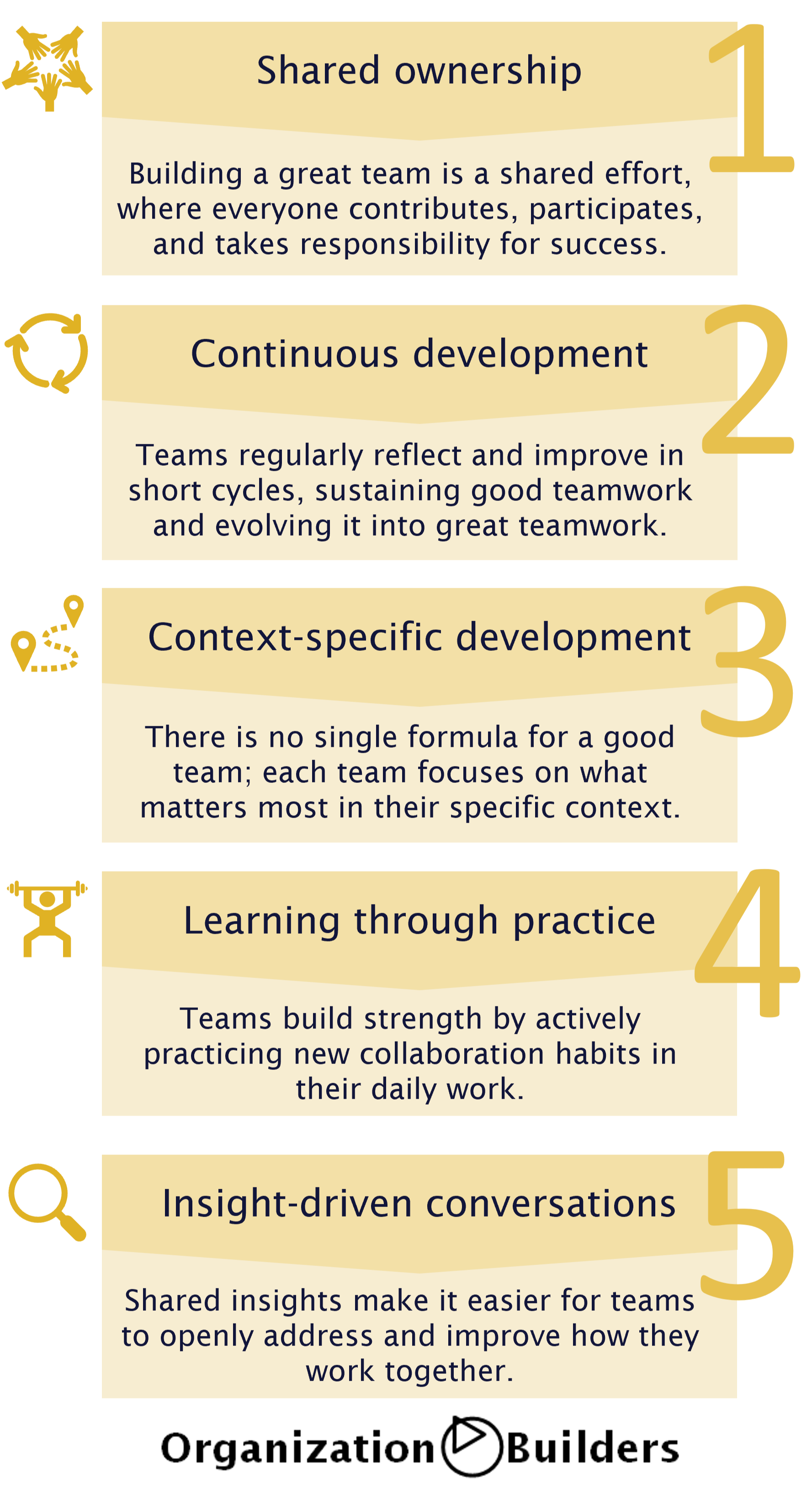
The 5 principles, to share with your network.