
The more HR rescues, the less managers own
HR has a structural tension at its core. You own the people agenda. But you don't own the people. You can design the process. But you can't run it for someone else. You can train a manager on how to have a great performance conversation, and then watch them not have it. This tension doesn't go away. But it can be designed around.
The most common mistake HR makes is resolving that tension in the wrong direction. When managers don't follow through, HR takes over. When conversations don't happen, HR schedules them. When processes aren't used, HR adds more steps, requires checklists, chases people, and sends reminders. None of this builds ownership. It builds dependency. And the more HR rescues, the less managers own.
The better question is not: how does HR do this well? It's: how does HR make it easy for managers to do this well?
That is a different job. It's a support model, not an execution model. And it requires a completely different way of thinking about what HR delivers, supporting quality instead of executing on behalf of others.
The 11 processes HR is responsible for
Across most organizations, HR is responsible for 11 core people processes: recruitment, onboarding, performance management, compensation, career pathing, succession, team building, offboarding, and conflict resolution. Every one of these processes has a decision owner who is not HR. The hiring decision is the responsibility of the hiring manager. The performance conversation belongs to the team lead. The career discussion belongs to the relationship between a person and their manager.
If managers are in the driving seat, HR is in the navigator seat. Most managers were never trained to manage. Without support, they default to instinct, which is inconsistent, or they escalate to HR, which creates bottlenecks. The opportunity is in the gap between those two options.
The 8 pillars that change the equation
What HR can do, and what most HR functions underinvest in, is build the infrastructure that makes managers effective. Not by taking over execution, but by building the system that makes success the easier path. Create the conditions in which managers can operate with confidence, consistency, and real ownership. There are eight ways to deliver this.
We call it the Driving Accountability Framework
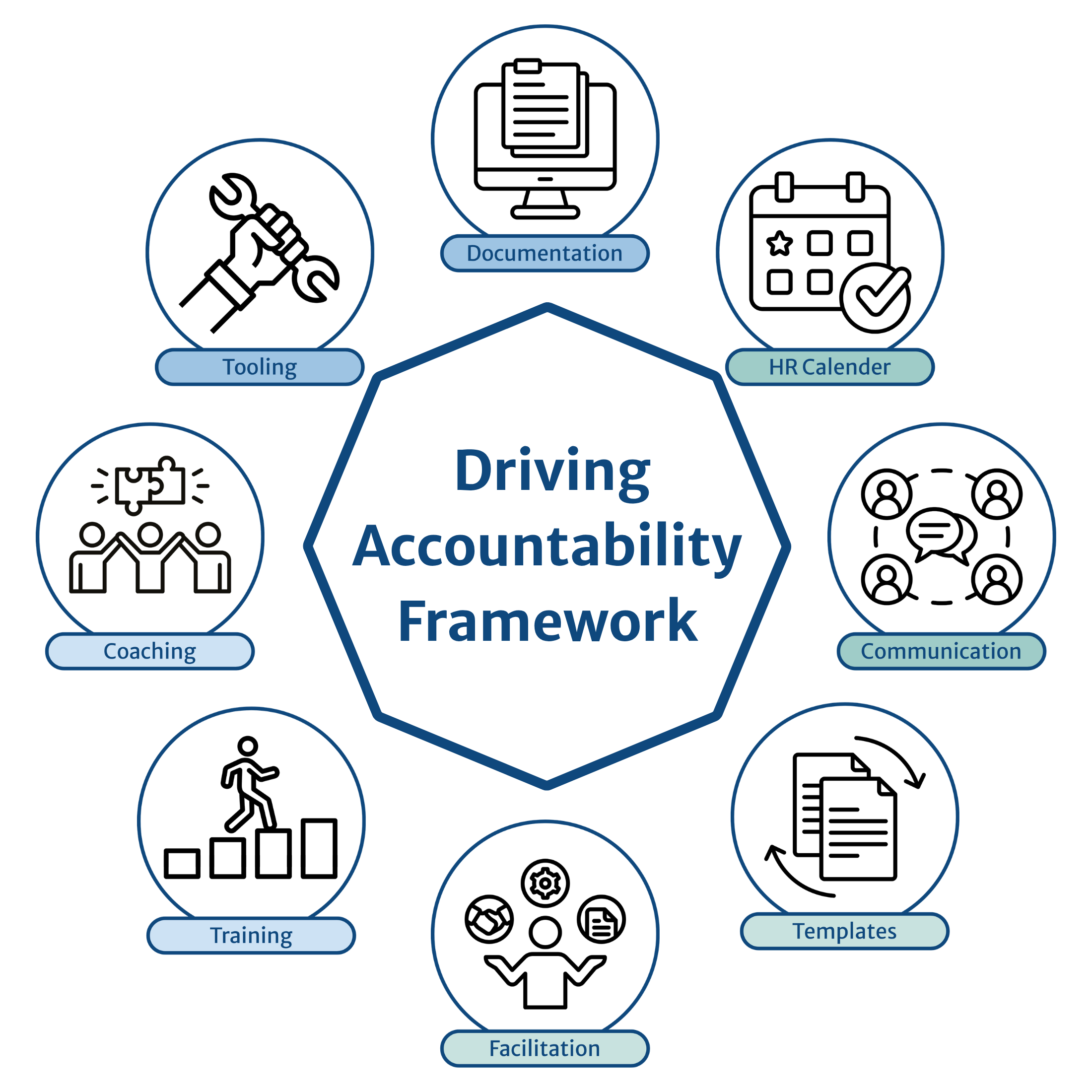
1. Documentation
Every HR process should be documented, accessible, and largely self-service. Documented clearly, in one place, with defined steps, roles, and timelines. The bar is simple: a manager who has never run a promotion process should be able to navigate it without asking HR. If they still have to ask, the documentation hasn't done its job.
2. Tooling
General HRIS platforms like HiBob or Personio, and targeted tools like CultureAmp or Teambooster, exist to make execution easy. HR's job is to ensure those tools are configured to how managers actually work, not how HR imagined they would. Efficiency and adoption depend on clarity. Good tooling makes work easier.
3. Training
New managers need real onboarding into the people processes they are now responsible for, a working understanding of what they own, what support exists, and what good looks like. Annual refreshers reinforce this when they are integrated into the process itself. The goal is long-term capability, not knowledge transfer for its own sake.
4. Facilitation
Some moments are too important to leave to chance. Facilitating key moments, performance calibration meetings, compensation cycles, and talent reviews is one of HR's clearest opportunities to demonstrate added value. HR should run these because quality matters, and HR has a unique position to set standards and create consistency. For other processes, HR should build run-of-show guides that allow teams to self-facilitate over time. The goal is quality now, independence later. That is a sequence, not a contradiction.
5. Coaching
Most issues that escalated were visible weeks earlier. HR Business Partners can strengthen this by building genuine coaching relationships with the managers they support, conducting proactive check-ins, holding structured feedback sessions, and providing a real sparring partner for the challenges of leading people. It's also one of the most rewarding.
6. HR calendar
An annual overview of all people moments, review cycles, salary windows, surveys, and calibration sessions, shared at the start of the year and reinforced with timely reminders, creates a predictable operating environment. Managers plan instead of reacting.
7. Templates
The moments that require the most skill from managers are also the moments when real-time support is hardest to find. One-page guides for key situations, what to prepare, how to frame it, and what to avoid consistently rank as the highest-used HR resource in organizations that invest in them. Not because managers are lazy. Because the moment of need is the moment that matters.
8. Communication
HR should communicate regularly about what it offers, what is coming, and what has changed, visible and useful updates in the channels where managers actually work. The best support model in the world doesn't exist for someone who's never heard of it.
What good looks like vs. what ineffective looks like
The eight pillars are easy to name. The harder question is whether they're actually working. Below is how the difference shows up in practice, using the performance conversation as a consistent example across all eight.
| ✓ What good looks like | ✗ What ineffective looks like |
|---|---|
| 1. Documentation | |
| There is an up-to-date online resource where you can always find an easy-to-read latest version of how it works. | HR communicates by email with lots of attachments to explain processes. |
| 2. Tooling | |
| The manager opens the performance module, sees their direct reports, and can log conversations in under five minutes. The tool feels fit for purpose and is easy to use. It prioritises usefulness over completeness. | The tool exists but it's used by part of the population. Information lives in multiple systems. HR chases completion rates. Managers log conversations in their own notes, or not at all. |
| 3. Training | |
| At the start of the calibration meeting there is a 45-minute exercise to learn better 1-on-1 performance dialogues. Managers find it useful. | You organize a half-day manager training on the full performance cycle but few people show up, with lots of last-minute cancellations. |
| 4. Facilitation | |
| By facilitating the calibration sessions, HR earns its seat at the table. Standards are consistent. Managers leave knowing what to say to their team. | Each leadership team runs its own calibration. Outcomes are inconsistent. Managers walk away with different readings of the same decisions. Or when HR facilitates, the meetings become low-energy and focused on process over content. |
| 5. Coaching | |
| The HRBP checks in two weeks before the cycle opens. One manager flags a difficult case early. They work through it before the conversation. | The difficult case arrives in HR's inbox as a formal complaint three weeks after the performance conversation went badly. Managers don't see the HRBP as a resource for their own growth as a leader. |
| 6. HR calendar | |
| In January, managers receive the full year's people calendar. They block time in March for performance conversations before the window opens. People processes get space on the calendar before everything else fills it. | The performance window opens Monday. Managers find out Friday. Conversations are rushed, rescheduled, or skipped. The process gets blamed for problems that belong to the planning. |
| 7. Templates | |
| The manager reads the one-pager on performance conversations the evening before. The conversation is structured, honest, and documented. | The manager improvises. The conversation drifts. No clear outcome is set. The employee leaves unsure what was decided. |
| 8. Communication | |
| Managers know the template exists because HR mentioned it in the monthly Slack update three weeks before the cycle. | Updates go out by email, land in crowded inboxes, and don't get read. The template exists. Nobody uses it. HR assumes it was found. It wasn't. |
When this is a pattern, not a process problem
If you read through the "ineffective" column and recognize it as normal, not as an occasional failure but as the default way things work, then you're looking at more than a process problem. You're looking at a culture problem. And that's a different conversation.
Process documentation that nobody uses. Tools that exist but don't get adopted. Managers who wait to be told what to do. These are symptoms of an organization where ownership hasn't landed. Where the habit of escalating to HR has replaced the habit of self-sufficiency. Where the system has trained people to wait rather than act.
This is precisely the pattern described in Why is building your culture not a project?, where culture sits between strategy and execution, invisible until it breaks, and never managed with the same rigor as your metrics.
The 8 pillars in this article are operational interventions. They reduce friction and create clarity. But if managers systematically don't use what HR provides, the question to ask is not "which pillar is missing?" The question is: what behavior pattern is the organization actually reinforcing?
In those situations, the 4-step culture model, Understand, Articulate, Change, Do, offers a more structured path. It starts not with fixing the process, but with naming the current reality honestly: what are managers actually doing, and why? From there, you can define a clear from-to, from reactive and dependent to proactive and self-sufficient. And from that from-to, you can design the interventions, which may well include strengthening the 8 pillars, but embedded in a deliberate change effort rather than as standalone fixes.
Culture work is business work. The 8 pillars are one lever. Used alone, they improve the system. Used inside a culture change effort, they shift the pattern.
What this changes
When these eight pillars are in place, something shifts. HR stops being the answer to every person's question and becomes the system that equips managers to answer those questions themselves. The 11 processes don't get taken away from managers. They get support in ways that make them run more smoothly.
The goal is not to create perfect HR processes. It's to create managers who don't need HR to hold their hand at every step. That is a harder thing to build. It requires HR to resist the pull toward doing. It requires investment in infrastructure that isn't immediately visible as HR work. And it requires patience, because the output is capability, not activity.
But the organizations that get this right move faster. People conversations happen when they should. Issues surface before they escalate. Managers own their teams, not in name, but in practice. That is process excellence. And HR builds it from the background.
If managers are still asking HR how the process works, HR hasn't finished building the support model yet.